

Key Takeaways
- Persian miniature painting, known as negargari, began as the art of illustrating royal manuscripts like the Shahnameh, and was inscribed by UNESCO as Intangible Cultural Heritage in 2020.
- The tradition travelled to India when Emperor Humayun recruited two Persian masters, Mir Sayyid Ali and Abd al Samad, during his exile in the 1540s. They reached Delhi in 1555 and founded the Mughal atelier.
- Rajasthani miniature painting adapted Mughal technique to Hindu devotional themes, producing icons like the Bani Thani of Kishangarh, often called the Mona Lisa of India.
- Kangra painting, the final flowering of this lineage, rose in the Himalayan foothills after artists dispersed from Delhi following Nadir Shah's invasion of 1739, and peaked under Maharaja Sansar Chand (r. 1775 to 1823). It received a GI tag in 2012.
- The same Persian design vocabulary that shaped these paintings, including the boteh or paisley motif, also shaped the Kashmiri shawl, connecting miniature art directly to textile crafts like Kani weaving and Sozni embroidery.
In this article: What is miniature painting? | Persian miniatures | The journey to India | Rajasthani painting | Kangra painting | What connects them | From brush to loom | FAQs
What Is Miniature Painting and Why Does It Matter?
Miniature painting is the art of creating small, intensely detailed paintings, historically made to illustrate books and manuscripts using natural pigments, gold, silver, and brushes sometimes made from a single squirrel hair. The word says nothing about the ambition of the form. Within a page smaller than a laptop screen, miniature painters compressed entire epics, court ceremonies, love stories, and landscapes.
Three of the greatest schools in this tradition are Persian miniature painting, Rajasthani miniature painting, and Kangra painting from the Punjab hills. They are usually studied separately. Seen together, they tell a single story: one artistic language travelling east over four centuries, transformed at every stop by the culture that received it.
What Is Persian Miniature Painting Called?
Persian miniature painting is known in Farsi as negargari. It developed as the art of the book, created to accompany the great works of Persian literature: Firdausi's Shahnameh (the Book of Kings), and the poetry of Nizami and Hafez. The most celebrated workshops were attached to royal courts, giving us the Herat school, home of the master Kamal ud Din Behzad, and the Tabriz school of the Safavid dynasty.

The hallmarks of Persian miniature art are unmistakable: jewel-like detail, flattened perspective with elevated viewpoints, calligraphy woven into the image, and a palette dominated by lapis lazuli blue and gold. Figures are idealised rather than realistic, because the goal was not portraiture but poetry made visible. In December 2020, UNESCO inscribed the art of miniature on its Representative List of the Intangible Cultural Heritage of Humanity, through a joint nomination by Iran, Turkey, Azerbaijan, and Uzbekistan.
How Did Persian Miniature Art Reach India?
Through one of history's most consequential artistic recruitments. When the Mughal emperor Humayun lost his throne and took refuge at the Safavid court of Shah Tahmasp in the 1540s, he encountered the finest painters alive. He persuaded two of them, Mir Sayyid Ali and Abd al Samad, to join his service. They reached his camp at Kabul around 1549 and accompanied him to Delhi in 1555, where they founded the imperial Mughal atelier.
Under Humayun's son Akbar, that atelier grew from around thirty artists to over a hundred, blending Persian refinement with Indian colour and energy. Its first great project, the enormous Hamzanama with some 1,400 paintings, was supervised by the two Persian masters themselves. A new visual language was born: Mughal painting, Persian in its bones, Indian in its blood.

What Is Rajasthani Miniature Painting?
Rajasthani miniature painting, also called Rajput painting, is the family of court styles that flourished in the princely states of Rajasthan from the 17th to the 19th century: Mewar, Marwar, Bundi, Kota, Bikaner, Jaipur, and most famously Kishangarh. As Mughal-trained artists sought new patrons, Rajput courts absorbed their techniques but redirected them entirely. Where Mughal painting documented emperors, Rajput painting worshipped gods.
The themes became Radha and Krishna, the Ragamala (paintings visualising musical ragas), the seasons, and courtly romance. The palette turned hot: flat planes of red, saffron, and yellow replacing Persian cool blues. Faces became stylised profiles rather than naturalistic portraits.

The summit of the school is the Bani Thani, painted around 1750 by the Kishangarh court artist Nihal Chand for his patron Raja Savant Singh, depicting the poet-singer who was the raja's muse. With her elongated eyes, arched eyebrows, and enigmatic calm, she is often called the Mona Lisa of India, and her image appeared on an Indian postage stamp in 1973.


What Is Kangra Painting and How Did It Begin?
Kangra painting is the most celebrated of the Pahari schools, the miniature traditions of the Himalayan hill states of present day Himachal Pradesh and Jammu. Its story begins with a catastrophe. In March 1739, the Persian ruler Nadir Shah sacked Delhi, and the Mughal capital's artistic community permanently dispersed. Many painters fled to the hill courts, carrying Mughal naturalism into the mountains.
There it met a tradition already in bloom. The hills had their own bold style at Basohli since the 1600s, fierce, hot-coloured, and intense. In the small state of Guler, the painter Pandit Seu and his sons Manaku and Nainsukh fused that native vigour with the arriving Mughal delicacy. Nainsukh (c. 1710 to 1778), who painted unusually intimate scenes of his patron Raja Balwant Singh of Jasrota, is widely regarded as the greatest of all Pahari masters.


The style reached its peak under Maharaja Sansar Chand of Kangra (r. 1775 to 1823), the greatest patron in the hills. His ateliers illustrated the Gita Govinda, the Bhagavata Purana, and Bihari's Sat Sai in a manner the world now recognises instantly: cool soft palettes, lush green landscapes fed by the Dhauladhar snows, and heroines of porcelain grace. Where Basohli was passion, Kangra is tenderness. In 2012, Kangra painting received a Geographical Indication (GI) tag, formally protecting its heritage.

What Connects Persian, Rajasthani and Kangra Miniature Painting?
A single, traceable lineage. Persian masters founded the Mughal atelier; Mughal-trained artists carried the craft to Rajput courts; and the dispersal of Delhi's painters after 1739 enriched the hills, where the Seu family perfected the Kangra idiom. Persia to Mughal Delhi to Rajasthan to Kangra: one river, four landscapes.
Shared materials and methods. All three traditions painted on layered handmade paper (wasli), burnished with agate to a lustre, using mineral and vegetable pigments, real gold and silver, and squirrel-hair brushes of astonishing fineness. A Kangra painter of 1790 and a Tabriz painter of 1525 would have recognised each other's tools instantly.


A shared purpose: painting as devotion. Each culture aimed the same art at what it held most sacred. Persia painted devotion to poetry and kingship through the Shahnameh. Rajasthan painted devotion to the divine, above all Krishna. Kangra painted devotion as tenderness itself, where even the landscape seems to feel Radha's longing. Here lies the poetic truth beneath the art history: the miniature was never merely decoration. It was a way of looking at the beloved, whether the beloved was a king, a god, or the world.
And each culture reshaped the inheritance. Persian art stayed loyal to the book. Rajasthan liberated the painting from the manuscript and gave it colour-saturated emotion. Kangra gave it landscape and intimacy. Same seed, three unmistakable flowers.
How Did Miniature Painting Shape the Kashmiri Shawl?
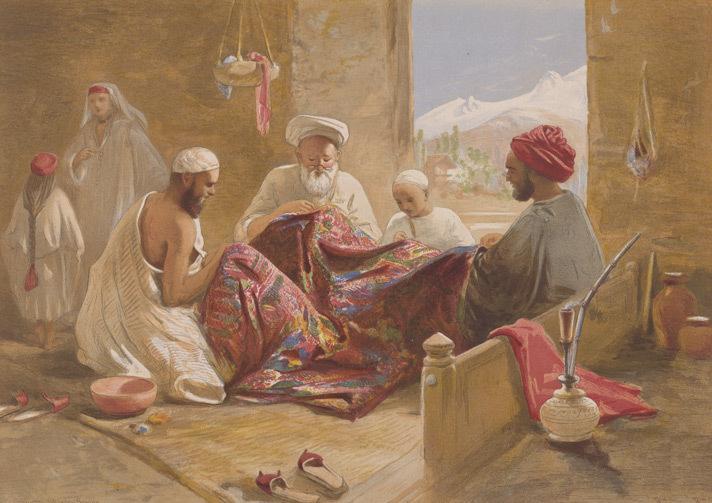
This lineage did not end on paper. It walked onto cloth. The boteh, the teardrop motif the world now calls paisley, is of Persian origin. Kashmiri historians credit Sultan Zain ul Abidin in the 15th century with promoting Persian decorative design in Kashmir, laying the foundations of the shawl industry. By the Mughal era, the boteh flourished on pashmina shawls woven in the valley, and in the 19th century those shawls carried the motif to Europe, where imitations woven in the Scottish town of Paisley gave it its English name.

The connection is structural, not coincidental. In Kashmir, the naqqash, the master pattern drawer, has always stood between painting and weaving, translating painted designs into the coded talim instructions that guide Kani loom weavers and the needle of Sozni embroidery. In the Pahari hills, the same relationship produced the Chamba rumal, embroidery based directly on Pahari painting, often described as painting in thread.

At Pashtush, this is not history. It is our working inheritance. Every Kani shawl on our looms and every Sozni embroidered Pashmina in our ateliers carries design DNA that travelled the same road as the paintings above: from Persia, through the Mughal workshops, into the valleys and hills of the Himalayas. When you drape one, you are wearing the same lineage that Nihal Chand painted and Nainsukh perfected.
Four generations of craft continue this story.
Explore our handcrafted Kani and Sozni collectionsFrequently Asked Questions
What is Persian miniature painting called?
Persian miniature painting is called negargari in Farsi. It developed as royal manuscript illustration, most famously for the Shahnameh, and was inscribed by UNESCO as Intangible Cultural Heritage of Humanity in 2020.
What is the difference between Rajasthani and Pahari painting?
Both are Rajput traditions, but Rajasthani painting comes from the desert courts of Rajasthan and favours hot, flat colours and bold stylisation, while Pahari painting comes from the Himalayan hill states and, especially at Kangra, favours soft cool palettes, naturalistic landscapes, and lyrical tenderness.
Who painted the Bani Thani?
The Bani Thani was painted around 1750 by Nihal Chand, court painter of Kishangarh, under the patronage of Raja Savant Singh. The original is housed in the National Museum, New Delhi.
Who was Nainsukh?
Nainsukh of Guler (c. 1710 to 1778) was the younger son of the painter Pandit Seu and is widely considered the greatest Pahari painter. His intimate portraits of Raja Balwant Singh of Jasrota transformed hill painting and shaped the later Kangra style.
What is the origin of the paisley motif?
The paisley is the Persian boteh, a teardrop motif of Iranian origin. It reached Kashmir by the 15th century, flourished on Mughal-era pashmina shawls, and took its English name from Paisley, Scotland, where imitation shawls were woven in the 19th century.
Is Kangra painting still practised today?
Yes. Kangra painting received a Geographical Indication tag in 2012, and revival efforts, including government training centres in the Kangra valley, continue to train new artists in the traditional techniques.